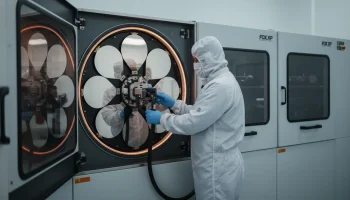
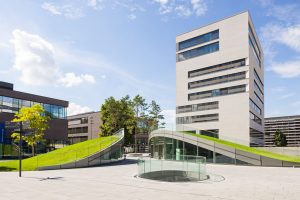
Building on the foundation of its first-generation system at the Leibniz Supercomputing Centre (LRZ), Q.ANT has successfully deployed its second-generation Native Processing Units (NPUs). These innovative photonic AI accelerators are designed to provide enhanced computational throughput while significantly improving energy efficiency.
The installation of these processors employs standard PCIe interfaces, allowing for seamless integration into existing high-performance computing (HPC) systems. This integration enables the NPUs to operate in conjunction with conventional CPUs and GPUs when handling artificial intelligence (AI) and scientific simulation workloads.
Benchmark evaluations conducted at LRZ have showcased substantial advancements in performance metrics with the Gen 2 architecture, signalling a pivotal step in Q.ANT’s robust product development trajectory. Notable improvements include:
- Over 50 times greater throughput for matrix multiplications.
- 25 times faster inference capabilities on a ResNet-18 convolutional neural network.
- 6 times lower energy consumption for standard workloads.
- Enhanced analog units that are optimised for nonlinear functions, leading to reduced parameter counts and training depth.
- Accuracy levels that meet the demands of state-of-the-art AI applications.
In contrast to traditional electronic processors that depend on transistor switching, Q.ANT’s photonic NPUs perform mathematical operations directly within the optical domain. This is achieved through the use of Thin-Film Lithium Niobate (TFLN) photonic integrated circuits, which effectively eliminate heat generation on-chip and the associated cooling requirements.
LRZ operates under rigorous standards, focusing on large-scale scientific simulations, AI research, and data-intensive applications. The installation of Q.ANT’s NPUs enables the centre to conduct thorough evaluations of photonic co-processing in a production environment, benchmarking performance, precision, and energy efficiency across heterogeneous HPC architectures.
This advancement is particularly significant for tackling industrial challenges associated with compute-intensive applications, such as drug discovery, materials design, and adaptive optimisation. In these domains, addressing nonlinear complexity and enhancing energy efficiency are critical.
For further insights and visual materials related to this announcement, please refer to the links below: